When the 1994 Doubleday Baseball League draft class was unveiled, the question dominating front-office discussions was whether Hideo Nomo or Andy Pettitte should go first overall. Nomo’s electric “tornado” delivery, four-star potential, and dominant Stuff rating made him the flashy pick. Pettitte, meanwhile, offered a steadier profile: lower peak Stuff, but higher projected Movement and Control — traits more likely to sustain long-term success.
A year later, the debate looks settled — at least for now. Pettitte’s first-overall selection appears justified.
Nomo’s Stagnation
On October 1, 1994, Nomo entered the draft pool with a 17 Stuff rating (matching his potential), 13 Movement, and 10 Control. Early evaluations suggested he could become a strikeout machine if his command caught up.
The problem? It never did.
Across 17 months of development tracking, Nomo’s Stuff has remained frozen at 16–17, with Movement gradually slipping from 13 to 11 and Control stuck in the 10–11 range. His potential ratings — once a promise of steady dominance — have declined in tandem. By March 1996, his ceiling in both Movement and Control had regressed, making his long-term projection look more like a volatile mid-rotation arm than an ace.
In scouting shorthand: the velocity is still there, but the life on his pitches and ability to locate are eroding.
Development Trends — The Numbers Don’t Lie
Hideo Nomo Development (Overall & Potential)
| Date | Stuff | Movement | Control | Stuff (POT) | Movement (POT) | Control (POT) |
|---|---|---|---|---|---|---|
| 1994-10-01 | 17 | 13 | 10 | 17 | 13 | 10 |
| 1994-11-02 | 17 | 13 | 10 | 17 | 13 | 13 |
| 1995-01-01 | 17 | 13 | 10 | 17 | 13 | 13 |
| 1995-04-01 | 16 | 12 | 10 | 16 | 12 | 12 |
| 1995-05-01 | 16 | 12 | 10 | 16 | 12 | 11 |
| 1995-06-01 | 16 | 12 | 10 | 16 | 12 | 10 |
| 1995-07-01 | 16 | 12 | 10 | 16 | 12 | 10 |
| 1995-08-01 | 16 | 12 | 10 | 16 | 12 | 10 |
| 1995-09-01 | 16 | 12 | 10 | 16 | 12 | 10 |
| 1995-10-22 | 16 | 11 | 10 | 16 | 11 | 10 |
| 1996-01-01 | 16 | 11 | 10 | 16 | 11 | 11 |
| 1996-03-02 | 16 | 11 | 10 | 16 | 11 | 11 |
Pettitte’s Steady Growth
Pettitte’s numbers tell a very different story. He began with just a 10 Stuff rating, but with Movement and Control already above average at 14 and 12, and room to grow into 16 and 14, respectively.
What happened next validates the “high-floor” scouting report. By mid-1995, Pettitte’s Movement reached 15 — a critical jump for limiting home runs — and his Control rose to 15, solidifying his ability to keep walks in check. Even without a huge spike in Stuff (peaking at 11), his pitch mix and command profile position him to be a consistent top-of-the-rotation workhorse.
His development curve shows stability — the kind that holds up under the wear of 200 innings per season.
Andy Pettitte Development (Overall & Potential)
| Date | Stuff | Movement | Control | Stuff (POT) | Movement (POT) | Control (POT) |
|---|---|---|---|---|---|---|
| 1994-10-01 | 10 | 14 | 12 | 11 | 16 | 14 |
| 1994-11-02 | 10 | 14 | 15 | 11 | 16 | 15 |
| 1995-01-01 | 10 | 14 | 15 | 11 | 16 | 15 |
| 1995-04-01 | 10 | 14 | 15 | 11 | 16 | 15 |
| 1995-05-01 | 10 | 15 | 15 | 11 | 16 | 15 |
| 1995-06-01 | 11 | 15 | 15 | 11 | 16 | 15 |
| 1995-07-01 | 11 | 15 | 15 | 11 | 16 | 15 |
| 1995-08-01 | 11 | 15 | 15 | 11 | 16 | 15 |
| 1995-09-01 | 11 | 15 | 15 | 11 | 16 | 15 |
| 1995-10-22 | 11 | 14 | 15 | 11 | 16 | 15 |
| 1996-01-01 | 11 | 14 | 15 | 11 | 16 | 15 |
| 1996-03-02 | 11 | 14 | 15 | 11 | 16 | 15 |
The Verdict
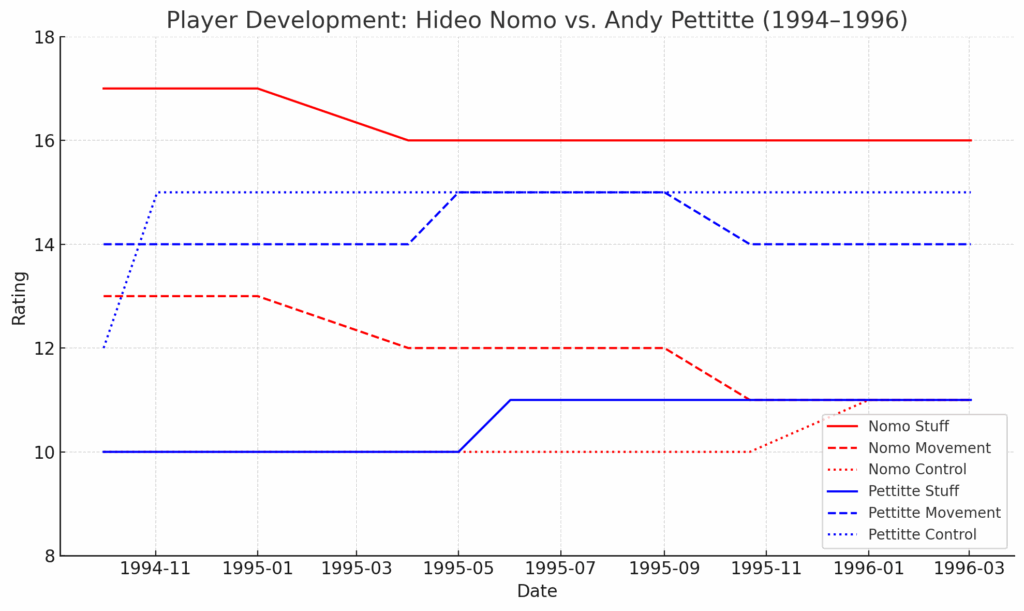
Last year’s draft debate boiled down to a choice between raw, volatile strikeout potential and dependable, repeatable command. In hindsight, Pettitte’s skill set — particularly the growth in Movement and Control — has translated into a much safer and more productive investment.
That doesn’t mean Nomo is a bust. His raw Stuff can still dominate on the right day, and a rebound in Movement or Control could reignite his star power. But from a value perspective, Pettitte has already begun delivering on the promise of the first overall pick, while Nomo remains more projection than production.
In the world of player development, consistency often beats flash. And for 1994’s draft class, Andy Pettitte is proving that point in real time.