As teams prepared for the 1995 season, trade activity surged following the conclusion of the 1994 campaign. Franchises navigated the market with different objectives—some aiming to acquire immediate impact players for contention, while others focused on rebuilding through prospect acquisitions. In total, there were 149 trades executed during this crucial offseason period. Below is a ranking of every team that executed trades, listed from most to least active.
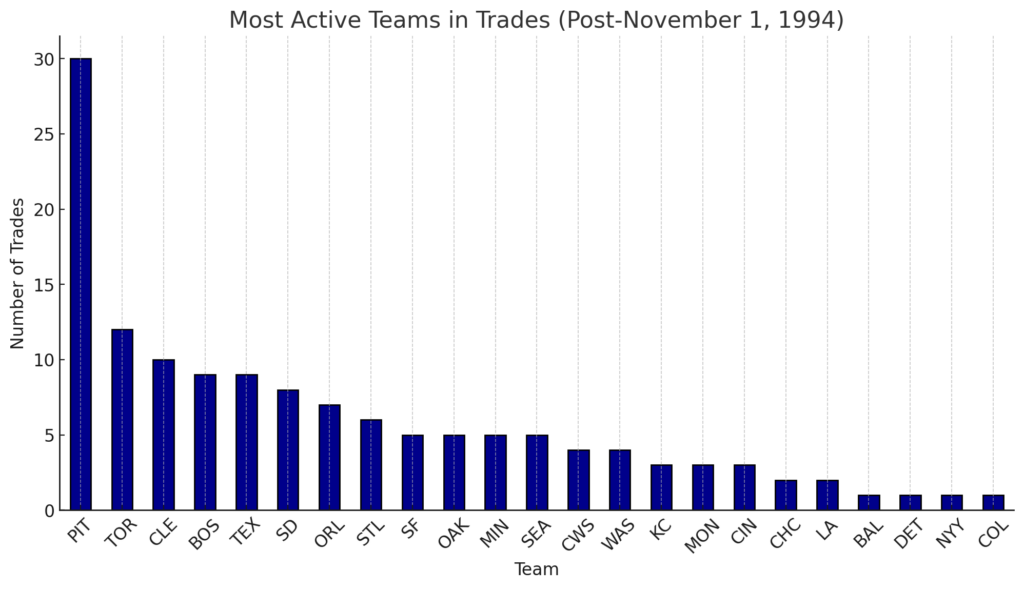
1. Pittsburgh Pirates (PIT) – 30 Trades
The Pirates were by far the busiest team, aggressively reshaping their roster through a mix of veteran acquisitions and prospect deals.
2. Toronto Blue Jays (TOR) – 12 Trades
Toronto engaged in multiple trades to bolster both their lineup and pitching staff, making calculated moves to strengthen their roster.
3. Cleveland Indians (CLE) – 10 Trades
Cleveland was heavily involved in trade talks, moving pieces strategically to stay competitive in their division.
4. Boston Red Sox (BOS) – 9 Trades
Boston’s front office made a series of moves aimed at fine-tuning their roster for a postseason run.
5. Texas Rangers (TEX) – 9 Trades
Texas balanced its trade activity between acquiring proven talent and setting up for future seasons with key prospect acquisitions.
6. San Diego Padres (SD) – 8 Trades
San Diego’s front office remained aggressive, making several deals to address key roster needs.
7. Orlando (ORL) – 7 Trades
Orlando was active in the trade market, primarily making moves to secure depth for the season ahead.
8. St. Louis Cardinals (STL) – 6 Trades
St. Louis focused on key role players to fill specific gaps in their lineup and pitching rotation.
9. San Francisco Giants (SF) – 5 Trades
San Francisco made selective trades, targeting players to complement their core lineup.
10. Oakland Athletics (OAK) – 5 Trades
Oakland followed its typical approach, moving players for financial flexibility and long-term sustainability.
11. Minnesota Twins (MIN) – 5 Trades
Minnesota kept a steady presence in the trade market, working to restructure parts of their roster.
12. Seattle Mariners (SEA) – 5 Trades
Seattle aimed to stay competitive by making smart trades to strengthen both their bullpen and offensive lineup.
13. Chicago White Sox (CWS) – 4 Trades
Chicago took a measured approach, making deals that added depth without overhauling their roster.
14. Washington Senators (WAS) – 4 Trades
Washington made moves aimed at long-term stability, balancing veteran experience with youth development.
15. Kansas City Royals (KC) – 3 Trades
Kansas City’s trade activity was more conservative, focusing on strategic roster tweaks.
16. Montreal Expos (MON) – 3 Trades
Montreal navigated the trade market cautiously, making smaller moves to round out their lineup.
17. Cincinnati Reds (CIN) – 3 Trades
Cincinnati’s trades were centered around bolstering specific positions rather than a full-scale rebuild.
18. Chicago Cubs (CHC) – 2 Trades
Chicago remained relatively quiet in the trade market, opting for minimal adjustments.
19. Los Angeles Dodgers (LA) – 2 Trades
Los Angeles engaged in a couple of trades, primarily focused on adding complementary pieces.
20. Baltimore Orioles (BAL) – 1 Trade
Baltimore made a single transaction, suggesting a more cautious approach to roster adjustments.
21. Detroit Tigers (DET) – 1 Trade
Detroit’s lone trade reflected a desire to make a targeted improvement rather than broad changes.
22. New York Yankees (NYY) – 1 Trade
The Yankees were largely inactive in the trade market, focusing on internal development.
23. Colorado Rockies (COL) – 1 Trade
Colorado engaged in just one trade, maintaining stability within their roster.
Conclusion
Post-November 1, 1994, the trade market was dominated by a few key teams, with Pittsburgh leading the way by a substantial margin. Some teams focused on win-now moves, while others were strategic in setting up for the future. These transactions played a pivotal role in shaping the 1995 season’s competitive landscape.